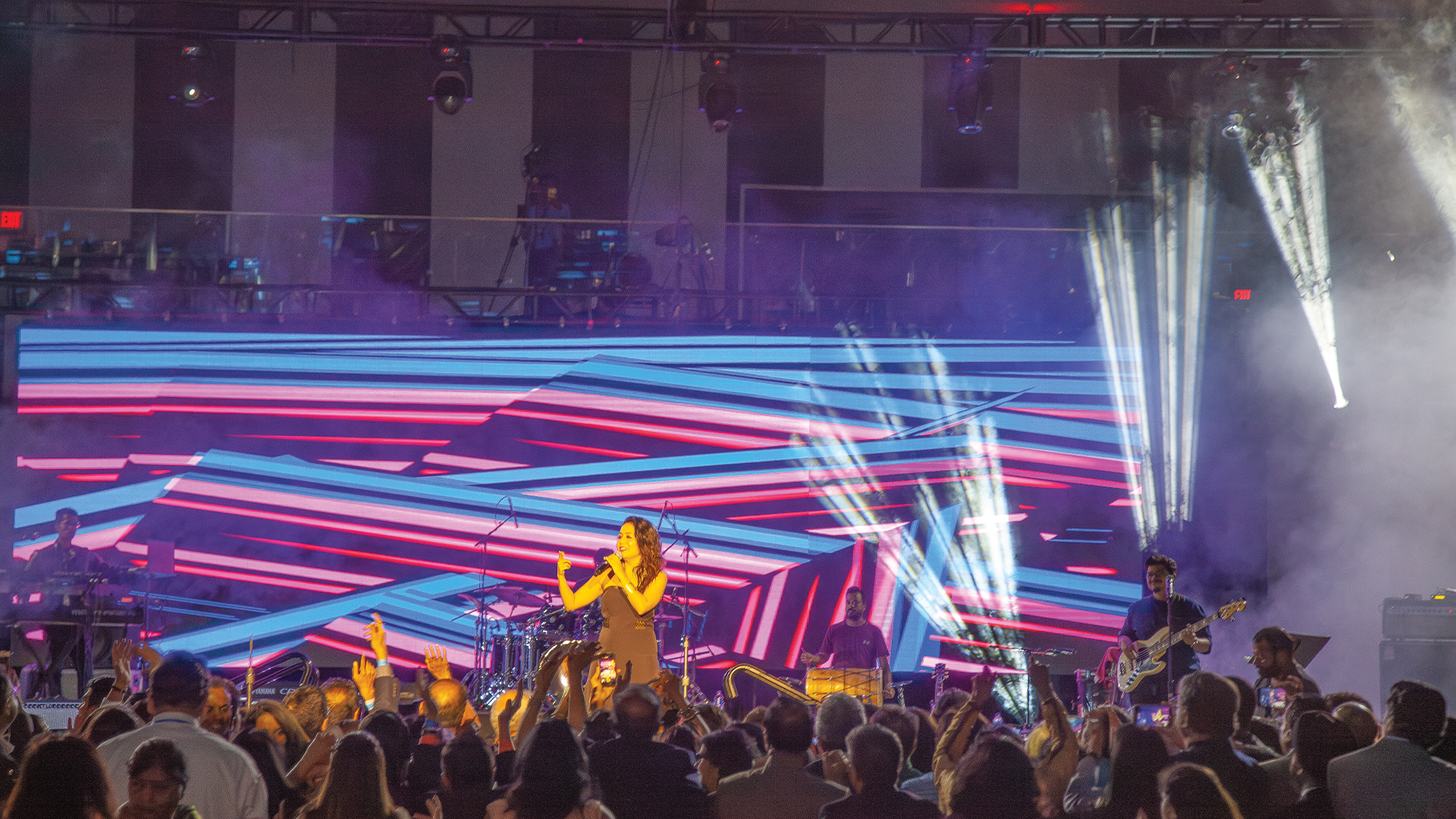
Attendees entered what appeared to be a rainforest LED panels overhead displayed moving canopy, side walls showed endless jungle extending in every direction, and the floor projection created the illusion of a forest path beneath their feet. This immersive walkthrough experience used LED technology to transport visitors into a completely different environment, demonstrating how LED displays create immersive environments that traditional scenic approaches cannot match.
Designing for 360-Degree Immersion
Complete environmental coverage distinguishes immersive experiences from conventional displays. When every visible surface displays coordinated content, peripheral vision receives consistent information that reinforces the illusion. Gaps in coverage visible ceilings, untreated walls—break immersion by reminding visitors they’re in a constructed space. Productions achieving true immersion address walls, ceiling, and sometimes floor with display or projection surfaces that create unified visual environments.
Perspective and parallax require sophisticated content design. Static imagery creates wallpaper rather than environment; content that responds to viewing position creates convincing space. Systems from disguise and 7thSense enable content that shifts based on viewer position, maintaining correct perspective as people move through spaces. This responsive content transforms flat surfaces into apparent windows onto other worlds.
Technical Infrastructure for Immersive Spaces
LED panel selection for immersive applications considers viewing distance, brightness requirements, and installation constraints. Fine-pitch panels (below 2mm) suit close viewing; coarser pitch works for ceiling applications viewed from greater distances. The ROE Visual Carbon CB5 and similar products designed for ceiling installation address the specific mounting and viewing angle requirements overhead applications present. Flexible LED from PixelFLEX enables curved surfaces that rigid panels cannot address.
Content synchronization across multiple display surfaces requires media server capability beyond basic playback. A forest environment might use separate content streams for canopy, left wall, right wall, and floor, all synchronized to create unified visual experience. Notch real-time graphics and TouchDesigner enable responsive content that adapts to space geometry and viewer interaction. The content pipeline from creation through delivery represents significant technical investment that immersive quality demands.
Audio Integration for Complete Immersion
Spatial audio completes immersive environments that visual elements alone cannot achieve. Sound that appears to originate from specific locations—birds calling from the canopy, water flowing from the forest floor—reinforces visual illusions with auditory information. L-Acoustics L-ISA, d&b Soundscape, and Meyer Sound Spacemap provide object-based spatial audio that positions sounds in three-dimensional space, creating sonic environments as enveloping as visual ones.
Haptic and environmental effects add physical sensations that deepen immersion further. Fog machines create atmospheric haze suggesting jungle humidity; scent diffusers add olfactory dimensions; floor vibration systems from D-BOX add physical sensation. These multisensory additions multiply immersive impact, creating experiences visitors describe as genuinely transporting rather than merely impressive.
Immersive walkthrough experiences represent the frontier of LED application—environments where technology becomes invisible and experience dominates. The investment in complete coverage, sophisticated content, and multisensory integration produces results that conventional approaches cannot approximate. Productions achieving true immersion create memories that attendees carry long after events conclude.
