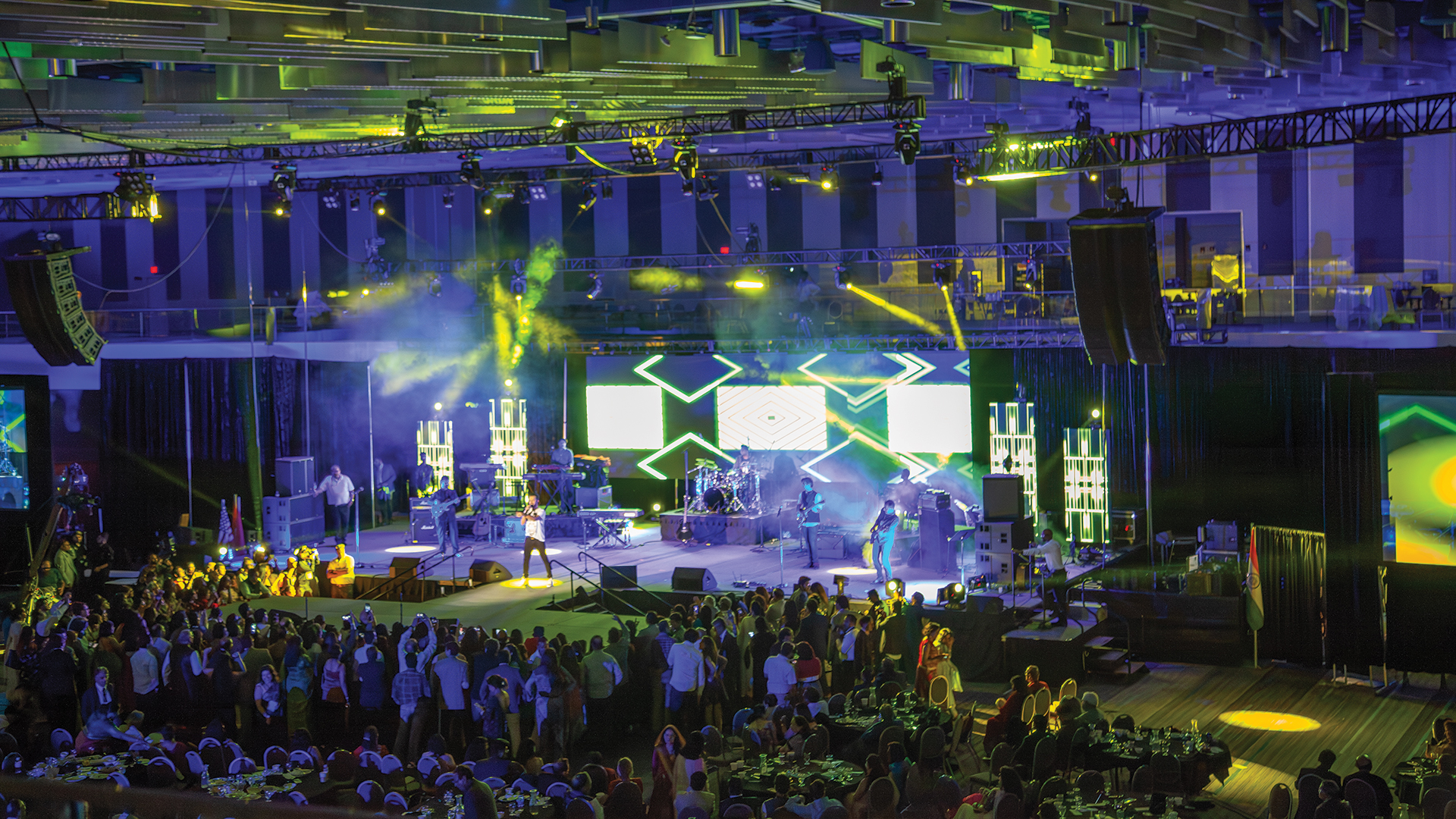
The delay towers were supposed to be invisible—functional infrastructure extending the main PA coverage to distant audience areas without drawing attention to themselves. Instead, they became the most prominent visual elements in the venue, their JBL VTX A12 arrays demanding attention like sulking teenagers at a family dinner. The production designer had specified scenic wraps; the audio department had vetoed them for acoustic reasons. Nobody won that argument—especially not the audience whose sightlines were dominated by black speaker boxes.
The Visual-Audio Conflict
Sound reinforcement and scenic design exist in perpetual tension. Speakers need to be positioned where physics dictates for optimal coverage. Scenic design wants clean sightlines and coherent visual aesthetics. These requirements frequently contradict each other, and resolution requires compromise from both disciplines—compromises neither typically wants to make.
The physics of sound propagation are unforgiving. A line array positioned ten feet lower than optimal loses high-frequency coverage across significant audience areas. Angling speakers to hide them behind scenic elements creates coverage shadows. The system engineer advocating for speaker positions isn’t being stubborn—they’re defending acoustic realities that no amount of creative wishing can change.
The Delay Tower Dilemma
Large venues require distributed speaker systems to deliver consistent sound pressure levels and intelligibility across extended audience areas. The main arrays handle front sections; delay towers or fill systems address areas beyond effective throw distance. This distributed approach is acoustically correct but visually intrusive—towers rising from the audience floor obstruct sightlines and contradict the immersive environment productions seek.
Solutions exist but require investment and planning. Meyer Sound PANTHER and similar compact line arrays reduce visual impact while maintaining acoustic performance. Steerable column speakers like the Renkus-Heinz Iconyx offer narrow vertical profiles. Some productions integrate speakers into scenic elements—towers disguised as architectural features or wrapped in LED surfaces displaying coordinated content.
Historical Context for Modern Conflicts
The tension between audio and visual elements has evolved alongside both technologies. Early rock concerts didn’t much care about aesthetics—speaker stacks were simply part of the experience. The evolution of concert production toward theatrical presentation raised expectations for visual coherence. Audiences who once accepted massive speaker columns now expect sound systems to somehow disappear.
The development of line array technology in the 1990s partially addressed this expectation. The L-Acoustics V-DOSC and subsequent systems demonstrated that effective coverage could be achieved with sleeker profiles than traditional point-source stacks. But the fundamental constraint remains: speakers must occupy space in positions where sound can reach audiences. No cabinet design eliminates this physical requirement.
Integration Strategies That Work
The most successful production designs treat audio as a design element rather than an afterthought. The scenic designer and audio system designer collaborate from project inception, identifying positions that serve both disciplines. Speaker locations become opportunities for visual statement rather than problems to hide.
Broadway productions increasingly integrate speakers into scenic architecture. The d&b audiotechnik E Series compact format facilitates installation in scenic elements without acoustic compromise. Hidden under-seat subwoofers provide low-frequency reinforcement without visible cabinets. These solutions require early coordination—retrofitting integrated audio into completed scenic designs rarely succeeds.
The Attention Economy of Sound
There’s an argument that visible speakers serve a purpose beyond their acoustic function. Concert audiences understand that large speaker systems indicate serious production investment. The visual presence of main PA arrays communicates scale and power before any music plays. Some designers intentionally make speakers prominent, treating them as visual elements that establish production credibility.
This philosophy conflicts with theatrical traditions where technology should be invisible, serving the story without drawing attention. The correct approach depends entirely on context: a rock concert might celebrate visible technology while a theatrical production requires seamless integration. Understanding which aesthetic applies—and designing accordingly—separates thoughtful production design from arbitrary equipment placement.
Future Directions in Invisible Audio
Research into directional audio technology continues advancing. Parametric speaker systems can direct sound to specific areas without conventional loudspeakers. Distributed mode loudspeakers use flat surfaces as radiating elements. These technologies aren’t yet practical for large-scale reinforcement but suggest future possibilities where speakers truly might disappear.
Until then, the negotiation continues. The PA towers will keep craving attention because physics requires them to exist in positions where attention finds them. The production designer will keep trying to hide them. And the production manager will keep mediating compromises that nobody loves but everyone can live with—the unglamorous work of turning competing requirements into functional productions.
Keywords: delay towers, JBL VTX A12, production designer, audio department, sound propagation, line array, system engineer, distributed speaker systems, Meyer Sound PANTHER, steerable column speakers, Renkus-Heinz Iconyx, evolution of concert production, line array technology, L-Acoustics V-DOSC, production designs, scenic designer, audio system designer, d&b audiotechnik E Series, under-seat subwoofers, main PA arrays, directional audio technology, distributed mode loudspeakers, production manager
