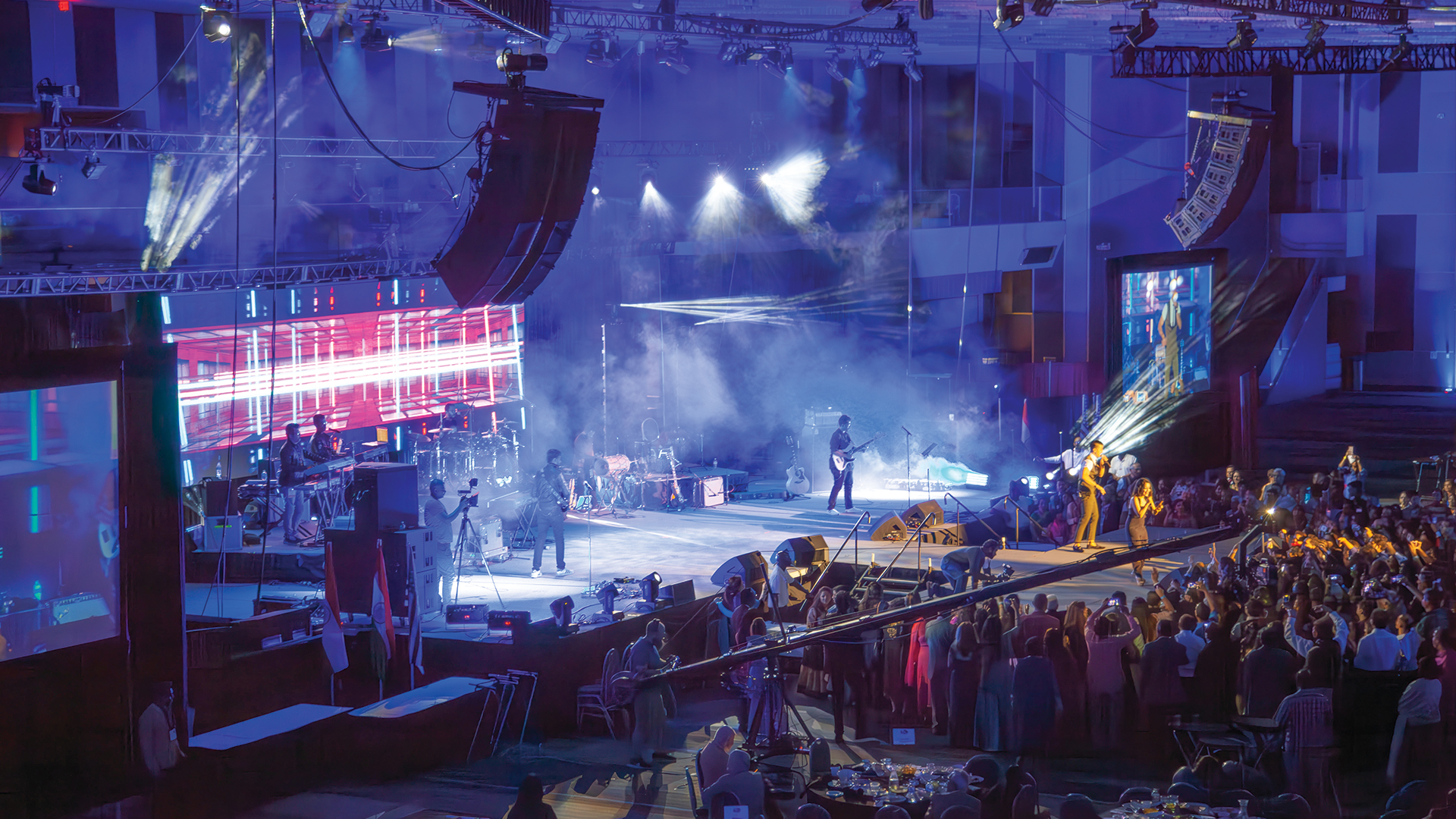
Stand at the back of a large ballroom during a corporate presentation powered by a conventional front-of-house speaker array. The sonic experience differs dramatically from seats near the stage. This acoustic inequality—where seating position determines comprehension quality—represents one of the most common failures in corporate AV production. Distributed audio systems exist specifically to solve this problem.
The physics are straightforward. Sound intensity decreases with the square of distance from its source—the inverse square law. Additionally, high frequencies attenuate faster than low frequencies—the atmospheric absorption phenomenon making distant sounds duller.
Distributed System Architecture
Delay speakers—the most common distributed element—position at intervals throughout audience areas. They receive the same audio signal as main systems but delayed to match arrival time from main speakers. Without this delay alignment, audiences hear content twice at different times, destroying intelligibility.
The delay calculation: approximately 1.1 milliseconds per foot of distance difference. Digital signal processors from QSC, Biamp, and Crestron provide the precise delay capability this alignment requires.
Fill speakers address coverage gaps—side fills for positions outside main coverage, down fills for areas where vertical coverage misses, under-balcony fills for areas blocked by architectural overhangs.
System Design Methodology
Professional design begins with venue acoustic measurement. Tools like EASE and MAPP XT model sound propagation through specific spaces, predicting coverage patterns and intelligibility metrics.
Speaker selection for distributed applications prioritizes pattern control over raw output. JBL VTX, L-Acoustics A Series, and d&b E Series feature the pattern control that distributed applications demand.
Speech Intelligibility Optimization
STI (Speech Transmission Index) measurement quantifies intelligibility numerically. Target values above 0.50 represent “good” intelligibility; values above 0.75 achieve “excellent” ratings.
Frequency response optimization for distributed speakers prioritizes the 1kHz-4kHz range critical for consonant perception—the frequency content distinguishing words from background.
The Alternative: Line Array Technology
Modern line array speaker systems from d&b audiotechnik, L-Acoustics, and Meyer Sound achieve some distributed benefits through main system design—directing energy toward distant areas while reducing output toward nearer positions.
However, line arrays cannot overcome fundamental physics. Extremely large venues, highly reverberant spaces, and complex room geometries still require distributed reinforcement. The technologies complement rather than replace each other.
Properly implemented distributed audio transforms audience experience from acoustically segregated to consistently excellent. The investment returns through measurable outcomes: higher comprehension ratings, reduced audience fatigue, and elimination of acoustic hierarchy making back-row seating feel like second-class participation.
