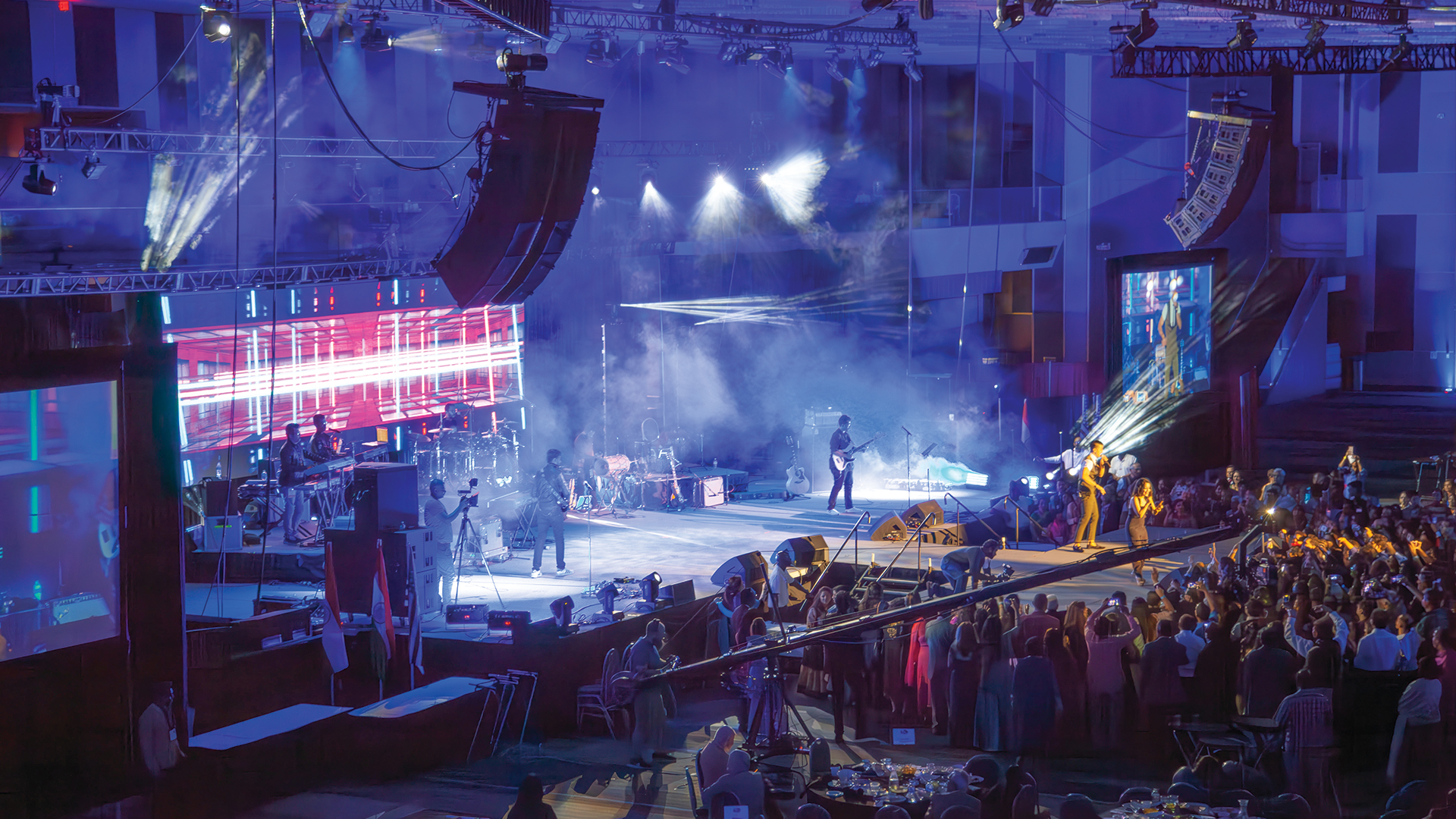
Closing the Distance: The Science of Delay Towers in Stadium-Scale Sound
When 75,000 audience members fill a stadium or outdoor festival site, the geometry of sound reinforcement becomes a battle against physics that no main hang can win alone. Sound travels at approximately 343 meters per second at sea level and 20 degrees C. An audience member standing 120 meters from the stage experiences 350 milliseconds of delay relative to stage output. Without delay tower infrastructure, rear-zone attendees hear a temporal smear of direct and reflected energy resulting in the intelligibility disaster that plagued outdoor concerts before modern sound reinforcement methodology.
The line array delay tower solves this with surgical elegance. By positioning mid-field and far-field delay positions at calculated distances from the main hang, and delaying their signal output to time-align with the arriving wavefront from the main system, engineers create seamless acoustic handoffs that maintain consistent level and intelligibility across the full audience depth. At events like Download Festival, Rock in Rio, or Wacken Open Air where audiences extend 200 meters from stage, delay tower networks of three or four zones are the difference between a world-class audio experience and an unintelligible disaster.
Tower Geometry: The Math Behind the Music
Effective delay tower placement is a product of acoustic modeling conducted in software platforms like L-Acoustics Soundvision, d&b ArrayCalc, EASE, or AFMG SpeakerLab before a single rigging point is established. Engineers optimize tower positions and hang angles to achieve SPL uniformity within plus or minus 3dB across the covered zone while maintaining frequency response consistency from 100Hz to 10kHz.
The crossover distance where delay tower coverage hands off from main hang coverage is typically calculated where the main system SPL falls 3dB below target. Tower systems are calibrated to arrive at the listener’s ear 0 to 10 milliseconds after the main system — the Haas effect precedence zone — which allows the brain to localize sound toward the stage despite the delay tower being physically closer. This psychoacoustic principle, first described by Helmut Haas in his 1949 doctoral dissertation, remains the foundational principle of all delay zone system design.
Hardware Choices for Delay Tower Applications
Not every line array cabinet suits delay tower duty. Mid-throw configurations typically require systems with controlled vertical dispersion of 10 to 15 degrees and horizontal coverage of 90 to 120 degrees. The L-Acoustics A15 and d&b audiotechnik V-Series are frequently specified for delay tower roles at major festivals, offering the directivity control needed to cover audience zones without exciting ground reflections or adjacent architectural surfaces.
Structural support for delay towers demands engineering certification equal to that of main stage rigging. Self-climbing ground-supported towers from suppliers like Prolyte, Global Truss, and James Thomas Engineering provide engineered solutions rated to specific wind load standards. A tower supporting eight line array cabinets at 10 meters height in an environment with Design Wind Speed 28m/s per BS EN 13814 represents a structural challenge demanding rigging engineering rigor equivalent to any other overhead load.
Delay Timing: Tools and Techniques
Setting delay times has evolved from rough calculations using distance measurements to precision real-time measurement using Rational Acoustics Smaart, Systune, or NoiseTools software. A measurement engineer positions a calibrated measurement microphone in the crossover zone between main hang and delay tower coverage, captures impulse responses from both systems simultaneously, and adjusts delay timing until the cross-correlation peak achieves maximum coherence at the measurement point.
Modern networked amplifier platforms — d&b D80, Lab.gruppen PLM Series, L-Acoustics LA12X — allow delay adjustments in real-time increments of 0.021 milliseconds. This precision enables temperature-compensated delay corrections — adjustments applied during the show as ambient temperature changes affect the speed of sound — a refinement applied by the most detail-obsessed systems engineers at long-duration outdoor events where temperature swings between soundcheck and headline sets can approach 15 degrees C.
The Human Experience in the Delay Zone
Ultimately, the delay tower system serves a human being standing 120 meters from a stage who deserves the same quality audio experience as the first-row audience member. The engineering detail enabling that experience — tower placement, signal delay, level matching, directivity optimization — is invisible to the audience member who simply experiences music with clarity and presence. For the systems engineers who design and tune these systems, that invisibility is the highest compliment. The 75,000-person festival audience experiences the illusion of uniform proximity to the performance, delivered by a network of precisely calibrated towers bridging the gap between human scale and stadium geometry.
